
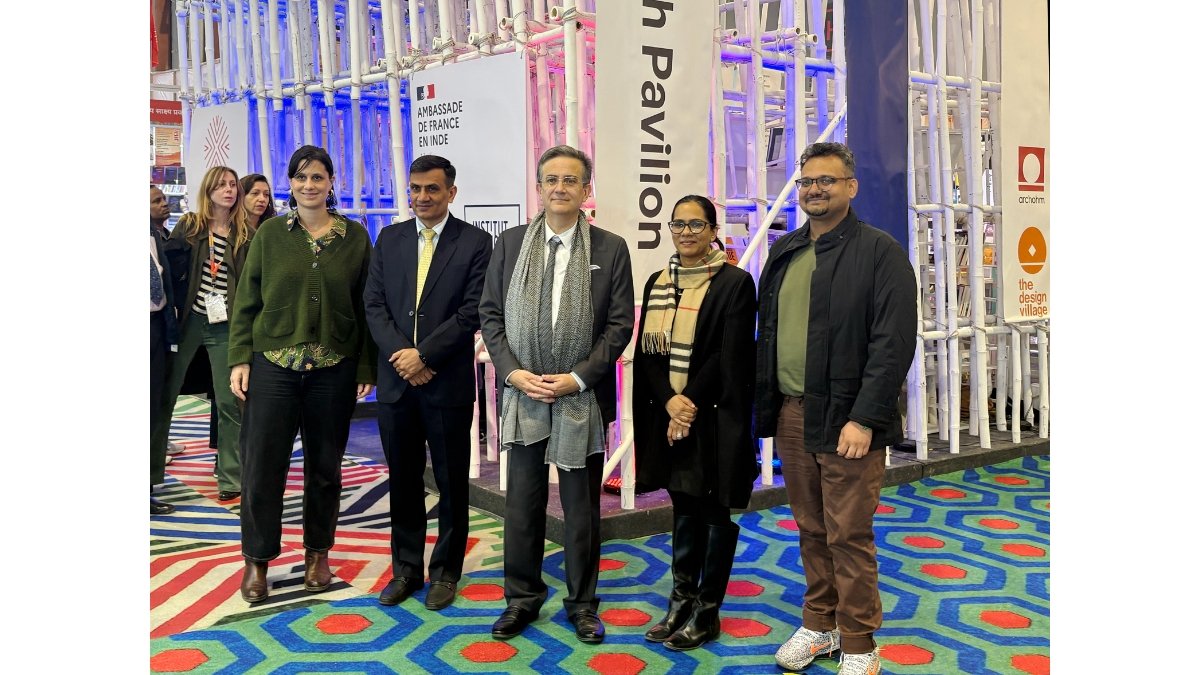
New Delhi [India], January 19: The Design Village (TDV), in collaboration with Studio Archohm, designed the French Pavilion at the World Book Fair, New Delhi, held at Bharat Mandapam from 10 to 18 January 2026, as part of France’s participation as Guest of Honour. The pavilion was conceived as an immersive and contemporary environment bringing together literature, architecture, and sustainability.
The pavilion presented French authors and publishers while highlighting the long-standing cultural dialogue between France and India. France’s participation aligned with President Macron’s visit to India in February 2026 and reflected ongoing cooperation supported by institutions such as the Institut Français en Inde (IFI) and the Indo-French Year of Innovation 2026 (IFYoI).
Commenting on the project, Mridu Sahai Patnaik, Co-Founder, The Design Village, said, “Being part of the French Pavilion project was an incredible journey. We contributed to creating a grand bamboo bookshelf, a living archive that celebrated the dialogue between French literary excellence and Indian vernacular knowledge systems. By choosing bamboo, the pavilion was rooted in the Indian context while honoring a material historically linked to the early history of writing itself. At its core, this project was a confluence of literature, architecture, and ecology, narrating a story of shared resilience and the enduring connection between nations through sustainable design.”
The architectural concept drew from Notre-Dame Cathedral, France’s most visited monument in 2025 and a UNESCO World Heritage Site. As a symbol of resilience, collective memory, and cultural heritage, Notre-Dame also held a close association with literature through Victor Hugo’s Notre-Dame de Paris, which informed the pavilion’s narrative approach to storytelling and space.
Grégor TRUMEL, Conseiller de coopération et d’action culturelle, Ambassade de France en Inde, Directeur de l’Institut français en Inde, said, “The French Pavilion is where one comes to access the latest French books, especially children’s books with their innovative designs and outstanding illustrations. This year, we also have an English section with iconic French books. To celebrate the India-France Year of Innovation 2026, we wanted the French Pavilion to be an architectural statement, a testimony to the high esteem we have for books as a nation. To shape our Pavilion like Notre-Dame de Paris was daring, but we immediately agreed with the proposal made by The Design Village and Archohm. The act of reading is not far from a sacred experience in the sense that it is an intimate dialogue with one’s own thoughts and ideas, usually done in solitude and contemplation. Conceiving the French Pavilion as a sanctuary for books also acts as a powerful symbol in an era where books continue to be banned in many countries for the ideas and messages they convey. The French Pavilion embodies the values of the circulation of knowledge and freedom of expression. And I love this literary “cathedral”, come and visit it, it’s just stunning!”
To root the structure within the Indian context, bamboo was selected as the primary construction material. A cornerstone of India’s vernacular architecture and a sustainable, renewable resource, bamboo also carried historical links to early writing systems and paper-making, reinforcing its relevance to the world of books.
“The French Pavilion hosted a series of conversations under the banner of “Future of Books” where Indian and French professionals discussed the profound transformations shaping the publishing landscape. We were delighted that these exchanges took place inside the French Pavilion, which offered an intimate and conducive setting for in-depth discussions,” added Julia TROUILLOUD, Attachée Culturelle pour le Livre et le Débat d’Idées, Cultural Attaché for Books, Debates & Ideas.
If you have any objection to this press release content, kindly contact pr.error.rectification@gmail.com to notify us. We will respond and rectify the situation in the next 24 hours.


